Written & Reviewed by Dr. Uttma Dham, DMD
General, Restorative & Cosmetic Dentist · Westside Dental Center, Plantation, FL · 20+ years of centeral experience · Fellow, Academy of General Dentistry · AAID Member
If you have a missing tooth or several you have probably heard the words "dental implant" more than once. Your dentist mentioned it. You may have Googled it at 11 pm and felt overwhelmed by technical jargon and pricing pages. Maybe someone you know got one and could not stop talking about how natural it feels.
This guide is written to give you a clear, honest, no-jargon answer to the question patients at Westside Dental Center ask us most often: what exactly is a dental implant, what does the process look like, and is it the right choice for me?
We will cover everything you need to know from the biology of how an implant bonds to your jawbone, to what a typical appointment timeline looks like in our Plantation, FL office. By the end, you will have enough information to have a real conversation with your dentist about whether implants make sense for your situation.
WHAT IS DENTAL IMPLANTS? THE SIMPLE EXPLANATION
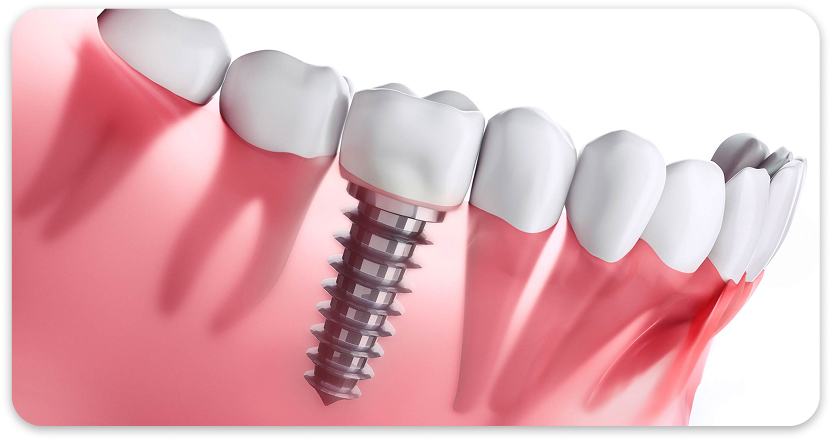
A dental implant is a small titanium post roughly the size and shape of a screw that is surgically placed into your jawbone to replace the root of a missing tooth. Once it bonds with the bone, a custom-made crown (the visible "tooth" part) is attached on top, giving you a replacement tooth that looks, feels, and functions almost identically to a natural one.
Think of it this way: when you lose a natural tooth, you lose two things the root below the gum line and the crown above it. Traditional dentures and bridges replace only the crown. A dental implant replaces both. That is what makes it the gold standard in modern tooth replacement.
The key difference from other options: A dental implant is the only tooth replacement that replaces the tooth root. That root replacement is what preserves the jawbone, prevents bone loss, and gives the implant its remarkable stability and longevity.
Long-term success rate for dental implants
Americans living with dental implants in 2025
Average lifespan with proper care
THE THREE PARTS OF DENTAL IMPLANTS
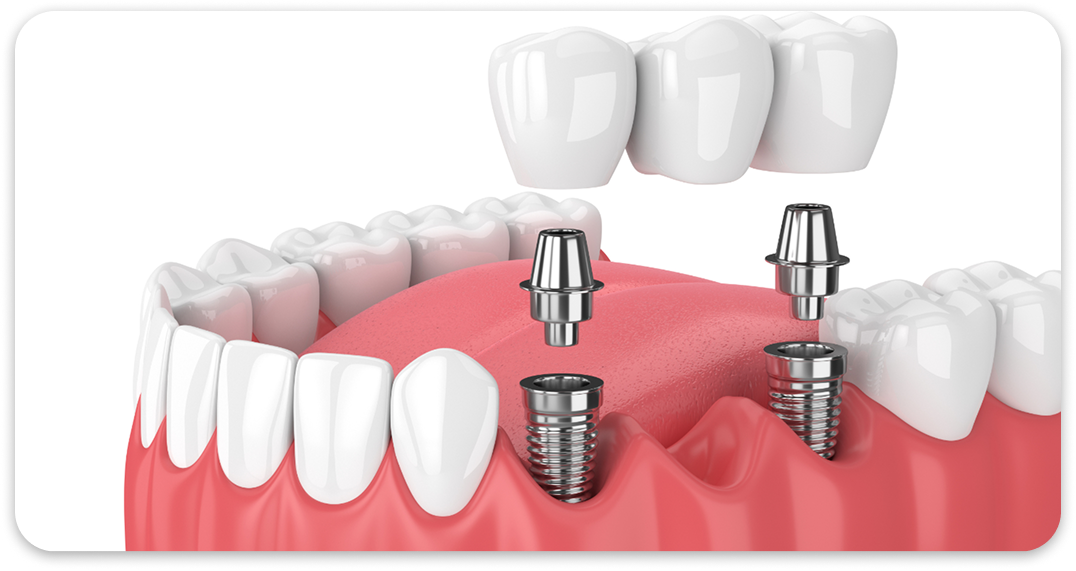
A dental implant is not one single piece, it is a three-component system. Understanding each part helps you understand why the process takes the time it does and why the outcome is so durable.
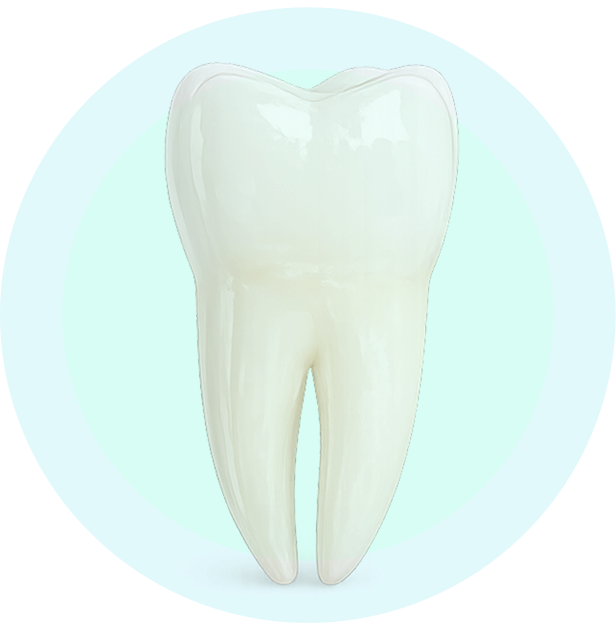
A titanium screw surgically placed into the jawbone. This is the "root" the foundation everything else rests on. Titanium is used because the body accepts it and bone will grow directly into its surface
A small connector piece that attaches to the top of the implant post once the bone has healed. It sits just above the gum line and holds the crown in place. Think of it as the "neck" of the tooth.
The custom-made visible portion of the tooth. At Westside Dental Center, crowns are designed and milled in-house using CAD/CAM technology matched precisely to the colour, shape, and size of your natural teeth.
HOW THE DENTAL IMPLANTS PROCEDURE WORKS - STEP BY STE
Dr. Dham reviews your dental and medical history, examines your gums and bite, and takes a CT 3D cone beam to scan a full three-dimensional image of your jaw, bone density, and nerve locations. This is not a standard X-ray. It gives us the complete picture we need to plan your implant safely and precisely before a single incision is made.
If you have insufficient bone density common in patients who have had a missing tooth for some time a bone graft may be recommended first to build a stable foundation. If a damaged tooth still needs to be removed, that extraction happens at this stage. Dr. Dham walks you through the full timeline, costs, and options before anything begins.
Under local anaesthesia and sedation if you prefer Dr. Dham makes a small incision in the gum, creates a carefully measured space in the bone, and places the titanium post. The gum is then closed. Most patients are surprised by how manageable the procedure is. You will feel pressure, but not pain. Recovery typically involves mild soreness for a few days, easily managed with over-the-counter medication.
This is the phase most patients are least familiar with, and it is the most important one. Over the next three to six months, your jawbone grows around the titanium post and fuses to its surface. This biological process called osseointegration is what gives the implant its extraordinary stability. You cannot rush it. But it is also completely natural and largely happens without you noticing much.
Once osseointegration is confirmed, a small connector piece the abutment is attached to the top of the implant post. In some cases this can be placed at the same time as the implant. Your gum tissue is then given a short period to heal around it.
Digital impressions are taken of the implant site, and your custom crown is designed and milled right here in our Plantation office using our in-house CAD/CAM technology. The crown is fitted, adjusted for your bite, and secured to the abutment. At this point, you have a complete, natural-looking tooth that functions just like the real thing.
At Westside Dental Center, we use CT-guided implant planning for every case. This means Dr. Dham maps the exact position, angle, and depth of your implant digitally before surgery — reducing risk, improving precision, and producing consistently better long-term outcomes for our patients in Plantation, Weston, Davie, and across Broward County.
OSSEOINTEGRATION-THE BIOLOGY THAT MAKES IMPLANTS SO DURABLE
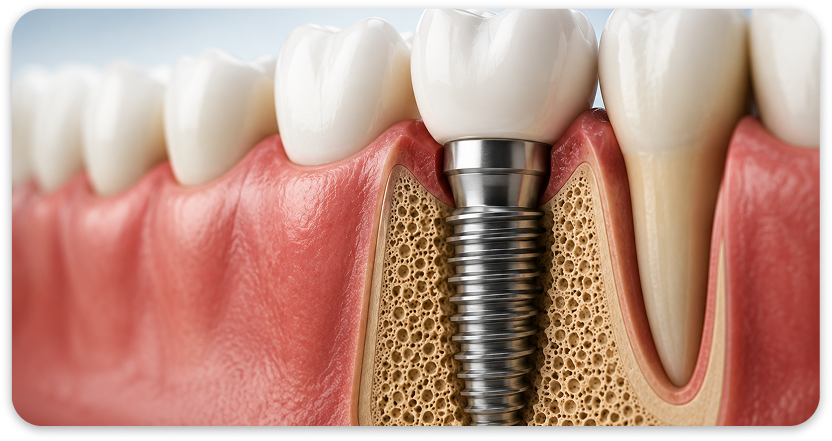
Osseointegration is the process by which your jawbone grows directly into the surface of the titanium implant post, creating a biological bond between living bone and metal. The word comes from the Latin "os" (bone) and "integrare" (to make whole). It is not glue. It is not a mechanical grip. It is your own bone tissue fusing with the implant at a cellular level.
This process happens in several phases. In the first hours after surgery, the body begins an inflammatory healing response the same one that heals any wound. Over the following days, specialised cells called osteoblasts (bone-forming cells) begin producing new bone tissue that grows into the microscopic texture of the implant surface. Over weeks and months, that new bone matures and hardens, until the implant is completely surrounded and anchored by dense, natural bone.
The titanium surface of modern implants is engineered specifically to encourage this process, micro-textured and sometimes coated with bioactive materials to increase bone-to-implant contact and accelerate healing. The result is an implant that, once fully integrated, can withstand the full forces of normal chewing typically 200 to 500 newtons of pressure depending on the location.
Why does this matter to you as a patient? Because osseointegration is what separates a dental implant from every other tooth replacement option. It is the reason implants feel like real teeth, last for decades, and actively protect your jawbone from the shrinkage that follows tooth loss.
WHO IS A GOOD CANDIDATE FOR DENTAL IMPLANTS?
Most healthy adults with one or more missing teeth are potential candidates for dental implants
Here is what Dr. Dham looks for during a consultation:
The implant needs solid bone to anchor into. Patients who have had missing teeth for some time may have experienced bone loss but a bone graft can often restore enough density to make implants viable.
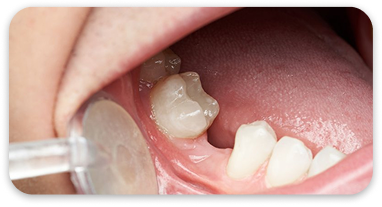
Active gum disease needs to be treated before implant placement. Placing an implant into an unhealthy mouth significantly increases the risk of failure. Dr. Dham assesses gum health thoroughly at the consultation stage.
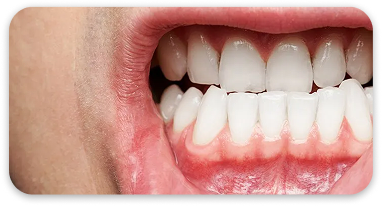
Conditions like uncontrolled diabetes or osteoporosis can affect healing and osseointegration. These are not automatic disqualifiers; they require careful case-by-case evaluation and sometimes medical clearance.
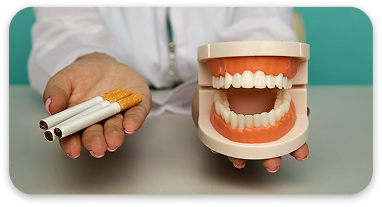
Smoking is the single biggest lifestyle risk factor for implant failure. It impairs healing and significantly reduces osseointegration success. Dr. Dham discusses this honestly with every patient who smokes before treatment begins.
If you are not sure whether you qualify, the only way to know is a proper centeral evaluation with a CT scan. A phone call or a quick Google search cannot tell you but a 45-minute consultation at Westside Dental Center can.
DENTAL IMPLANTS VS DENTURES VS BRIDGES - AN HONEST COMPARISION
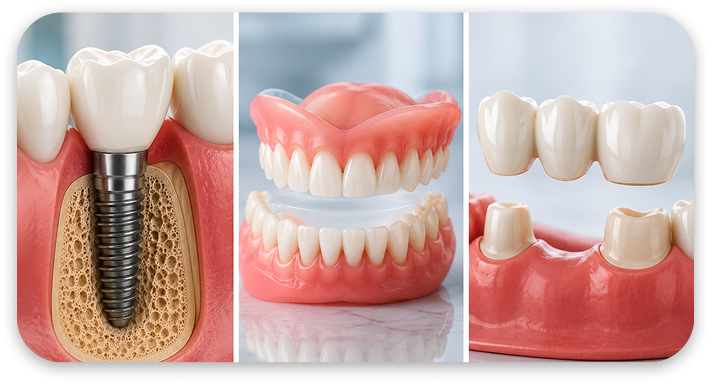
There are three main ways to replace missing teeth. Each has genuine merit for different patients and different situations. Here is a straightforward comparison:
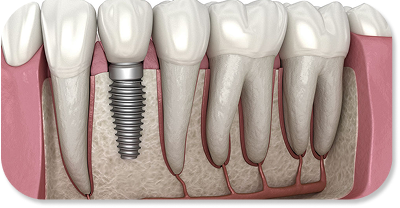
Replace root and crown. Prevent jawbone loss. Feel and function like natural teeth. Last 20–25 years with proper care. No impact on adjacent teeth. Highest upfront cost best long-term value.
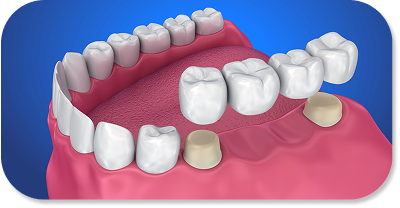
Crowns placed on teeth either side of the gap support a false tooth in between. No surgery required. Does not replace the root, so bone loss continues. Adjacent healthy teeth must be permanently altered.
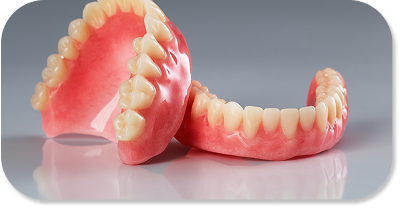
Full or partial removable plates. Lower upfront cost. Do not replace the root bone loss accelerates over time. Can feel loose or uncomfortable. May require adjustment as the jaw changes shape.
DENTAL IMPLANTS VS DENTURES VS BRIDGES - AN HONEST COMPARISION
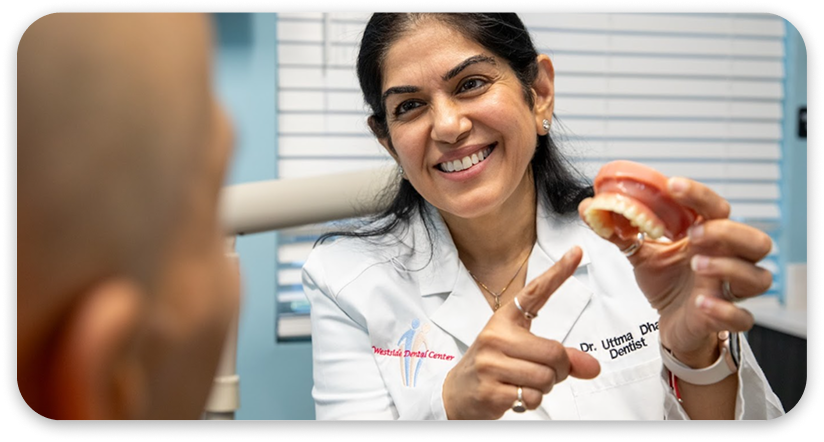
At Westside Dental Center in Plantation, FL, Dr. Dham has been placing dental implants for over 20 years. As a member of the American Academy of Implant Dentistry (AAID) and a Fellow of the Academy of General Dentistry, she brings a level of training and centeral experience that most general practices in Broward County simply do not offer.
What that means in practice for patients from Plantation, Weston, Davie, Sunrise, Tamarac, Cooper City, Southwest Ranches, Coral Springs, Fort Lauderdale, and Parkland who come to us for implants:
Same-day consultations available. If you have been living with a missing tooth and wondering whether an implant is right for you, the conversation starts with a free consultation at our Plantation office. Call (954) 251-0640 or book online new patients across Broward County are always welcome.
DENTAL IMPLANTS AT WESTSIDE DENTAL CENTER - WHAT MAKES OUR APPROACH DIFFERENT
With proper care brushing, flossing, and regular check-ups dental implants can last 20 to 25 years or longer. The implant post itself can last a lifetime. The crown may eventually need replacing after 10 to 15 years depending on wear, but the foundation beneath it remains intact.
Most patients are genuinely surprised by how manageable it is. The procedure is carried out under local anaesthesia, so you feel pressure but not pain during surgery. Post-operative soreness is typically mild and resolves within a few days with over-the-counter pain relief and soft foods. Sedation is available at Westside Dental Center for patients who feel anxious.
The cost varies depending on the number of implants, the complexity of the case, whether bone grafting is needed, and your insurance coverage. At Westside Dental Center, Dr. Dham provides a full, transparent cost breakdown before any treatment begins, no surprises, no hidden fees. We also offer financing options to spread the cost over time.
From consultation to final crown, the typical timeline is three to six months, most of which is waiting for osseointegration (the bone healing phase) to complete. If bone grafting is needed first, the overall process may take longer. Dr. Dham gives every patient a personalized timeline at their first appointment.
Possibly yes, but it is more complex. When a tooth has been missing for a long time, the jawbone in that area starts to shrink a process called bone resorption. If there is insufficient bone density, a bone graft is usually performed first to rebuild the foundation. This adds time to the process, but for the right patient it is absolutely worth it.
Coverage varies widely by plan. Some dental insurance plans cover part of the cost, particularly the crown or the consultation. Others do not cover implants at all. Our team at Westside Dental Center will verify your coverage before your appointment and walk you through your benefits so there are no surprises on the day.
When placed by a trained, experienced dentist in a medically appropriate candidate, dental implants have a success rate of 95 to 98% over ten years, one of the highest of any elective dental procedure. The key factors are bone quality, overall health, and adherence to aftercare instructions. At Westside Dental Center, Dr. Dham's CT-guided planning process is specifically designed to maximise that success rate for every patient.
Dr. Dham and her team serve patients from Plantation, Weston, Davie, Sunrise, Tamarac, Cooper City, Southwest Ranches, Coral Springs, Fort Lauderdale, and Parkland. A free consultation includes a full assessment, CT imaging discussion, and a transparent treatment plan with no pressure and no hidden costs.